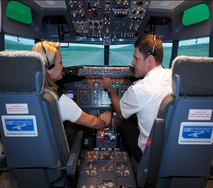
Etihad Airways Pilot assessment is a three day selection process that consist of:
1 - Online interview (HireVue)
2 - Pilot aptitude tests
3 - Technical Exam
4 - Simulator Assessment
5 - Panel Interview (Human Resource Questions)
Etihad Airways Pilot Interview Gouge was last updated on 16 November, 2026
The information on this page has been submitted to us by pilots attending Etihad Airways pilot interview and sharing their experience with us. The content on this page should only be used for preparation purposes.
The video Interview consist of online Human Resource questions that canditates have to answer online through a computer:
Our video interview question bank consist of 20 questions that users have submitted to us!
Free Version >>Disclaimer!! We hereby notify you that there is no express or implied affiliation or endorsement between the original software producer of the pilot aptitude tests listed below and www.latestpilotjobs.com, and that information herein is provided on an as is basis with no guarantees made for accuracy. COMPASS™ is a registered trademark of "COMPASS™ International B.V" and is in no way affiliated with or endorsed by www.latestpilotjobs.com. The pilot aptitude tests on this website shall not be used for real pilot selections and should only be used for preparation purposes only. For any information about COMPASS™, please only contact the "COMPASS™ International B.V" directly.
Both short-term memory and tolerance for stress will be assessed in this simulation. You will constantly be confronted with new information about altitude, heading, airspeed and radio frequencies and asked to memorize and reproduce this information.
Short Term Memory features 3 different levels (easy, medium and hard). Each level has time-limited rounds in which you have to memorize the information and answer each question correctly. At the end of the test, a score will be calculated.
This is a test to assess your spatial awareness and ability to read instruments. In other words, you need to understand the aircraft's attitude and position in physical space. You will be asked to pick the correct aircraft on the basis of the readings on the cockpit instruments.
The Spatial Awareness test features a practice section with 20 questions, each with a detailed explanation of the answer. The test section features 3 different levels (easy, medium and hard). Each level will have a 10 random, time-limited questions and a exact score will be calculated afterwards.
This test measures your multitasking skills. You will constantly be receiving information (digits) and you will be asked to enter them in the primary flight display by using the arrows and numbers on your keyboard. At the same time, alert signs will be displayed that need to be eliminated.
The Multitasking test features 3 different levels (easy, medium and hard). Each level is time limited. At the end of the test, a score will be calculated based on how accurately you entered the numbers in the primary flight display and eliminated the alert signs.
This test measures your psycho-motor and multi tasking skills. Test takers must adjust airspeed, heading, altitude and slip ball coordinator simultaneously to maintain the given target values.
The Advanced Flight Control has a 5 minute time limit. A score, based on your performance will be given in percentages. For optimum results, we recommend the use of a joystick and rudder pedals for this test.
How do you really perform in the cockpit when it counts? The Pilot Personality Profile is a 50-question self-assessment for experienced pilots.
It measures the 10 qualities airline assessors look for, including procedural discipline, situational awareness, decision-making, CRM, leadership and risk management.
When you finish, you get a personal report with your pilot profile, your key strengths and development areas, a hazardous-attitude check and practical tips for your next airline assessment or interview.
General knowledge test consist of ATPL questions (50 questions, 45 min).
What does the abbreviation DER means?
Answer: Departure end of runway
Why are Flight Level intervals increased to 2000 ft in non RVSM airspace?
Answer: Because of altimeter errors (lower air density). Reduced vertical RVSM to 1000ft separation above FL290 is granted to aircraft with advanced and more accurate altimeters, usually crowded routes (Trans Atlantic Routes).
What are the two types of taxiway lightning systems?
Answer: 1) One line of green taxiway centreline lights. 2) Two lines of blue taxiway edge lights.
Subscribe to see the remaining questions submitted to us!
The Tech Exam is part of the ATPL Questions:
Our software consist of more than 700 questions from the Airbus 320 / Boeing 737 Technical Questions, such as system, automation, limitations, and many more.
Non Rated Pilots
The non-type rated sim is a normal takeoff with autopilot engaged at 1000ft...intercept,,,,,,,,,,,,,,,,,,,,,,
Type Rated Pilots
A visual approach and you will be asked to go around . About 100 feet off the ground ,,,,,,,,,,,,,,,,,,,,
Subscribe to see a detailed simulator scenario. We will also assist you with information on how to be successful during your simulator session.
Approach Plates will be provided
The interview will usually last no longer than one hour. Generally, the panel includes one person from recruitment and a manager. We have created a question bank based on the questions we have received from candidate’s attending the assessment and sharing their experience with us. The questions are split into two sections. Human Resource type questions and flying based questions. Few examples below:
• Tell us about yourself?
• Why do you want to work for us? Any time a Captain / First Officer didn't agree with you?